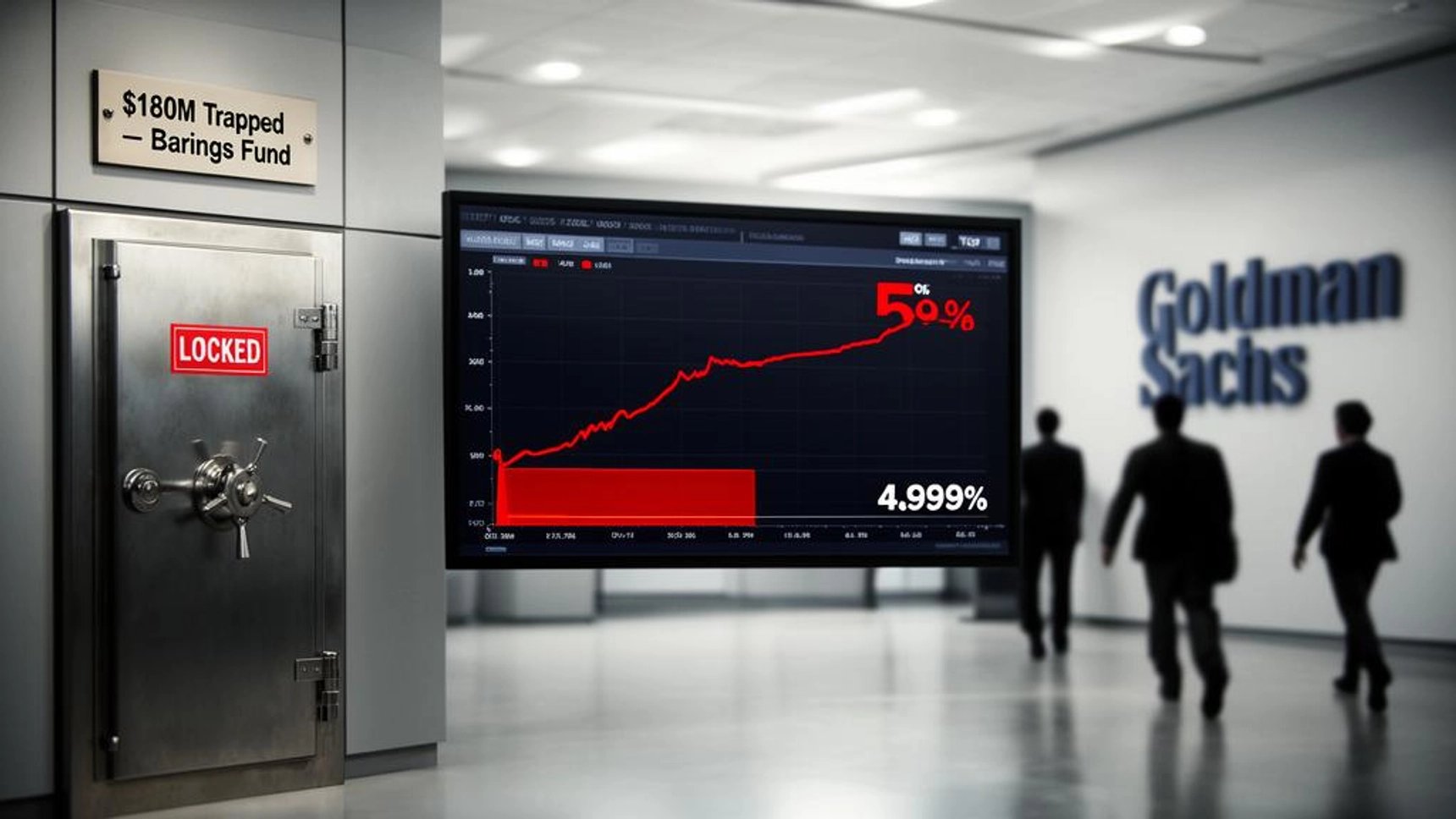
Barings has capped withdrawals at one of its private credit funds after redemption requests spiked, preventing investors from freely accessing their money. The asset manager imposed the limit on the fund to manage the surge in withdrawal requests.
The move reflects a broader wave of redemptions hitting private credit funds. The $1.8 trillion leveraged private credit market has become a focal point for financial stability concerns as investors reassess their positions.
Goldman Sachs disclosed in a Q1 letter to its credit shareholders that repurchase requests represented less than 5% of shares as of December 31, lower than the firm's quarterly repurchase cap. The firm stated in the letter that it believes these results highlight the strong position of its credit fund relative to the broader non-traded business development company industry.
The Goldman fund's ability to keep redemptions below its quarterly cap signals that investors at that firm are not panicking, even as others flee private credit exposure.
JPMorgan Chase CEO Jamie Dimon wrote in his annual letter to shareholders that private credit probably does not present a systemic risk in the great scheme of things. He noted that the leveraged private credit market totals $1.8 trillion, while investment-grade bonds total $13 trillion and residential mortgage securities and loans also total $13 trillion.
Yet Dimon acknowledged real vulnerabilities. He wrote that a downturn in credit, which will happen one day, will lead to higher than expected losses on all leveraged lending because credit standards have been modestly weakening across the board. Private credit does not tend to have great transparency or rigorous valuation marks of loans, which increases the chance that people will sell if they think the environment will get worse, even if actual realized losses barely change, he added.
Barings' withdrawal cap demonstrates that investors are already making those sell decisions, regardless of whether fundamental losses have materialized.
Barings has capped withdrawals at one of its private credit funds after redemption requests spiked, preventing investors from freely accessing their money. The asset manager imposed the limit on the fund to manage the surge in withdrawal requests, a concrete constraint on investor liquidity that signals stress in the sector.
The move reflects a broader wave of redemptions hitting private credit funds. Fears that artificial intelligence could erode earnings power of software companies and weaken their ability to repay loans are rippling through the private credit industry, prompting investors to reassess their exposure and redemption risks. The $1.8 trillion leveraged private credit market has become a focal point for financial stability concerns as investors reassess their positions.
Goldman Sachs disclosed in a first-quarter letter to credit shareholders that repurchase requests represented less than 5% of shares as of December 31, lower than the firm's quarterly repurchase cap. The firm stated in the letter that it believes these results highlight the strong position of its credit fund relative to the broader non-traded business development company industry.
Goldman's resilience contrasts sharply with Barings' action and broader sector stress. The Goldman fund's ability to keep redemptions below its quarterly cap signals that investors at that firm are not panicking, even as others flee private credit exposure.
JPMorgan Chase CEO Jamie Dimon wrote in his annual letter to shareholders that private credit probably does not present a systemic risk in the great scheme of things. He noted that the leveraged private credit market totals $1.8 trillion, while investment-grade bonds total $13 trillion and residential mortgage securities and loans also total $13 trillion.
Yet Dimon acknowledged real vulnerabilities. He wrote that a downturn in credit, which will happen one day, will lead to higher than expected losses on all leveraged lending because credit standards have been modestly weakening across the board. Private credit does not tend to have great transparency or rigorous valuation marks of loans, which increases the chance that people will sell if they think the environment will get worse, even if actual realized losses barely change, he added.
Barings' withdrawal cap demonstrates that investors are already making those sell decisions, regardless of whether fundamental losses have materialized.
Highlighted text was flagged by the council. Tap to see feedback.