


Congress votes to shift control from scientists to provinces
Argentina's lower house of Congress approved a bill early Thursday that weakens protections for the country's glaciers, clearing the way for mining in frozen regions of the Andes mountains. The amendment to the Glacier Law, already approved by the Senate in February 2026, transfers authority over which glacier areas deserve protection from the Argentine Institute for Snow, Ice and Environmental Sciences to individual provincial governments.
President Javier Milei championed the reform, arguing it would "empower the provinces to utilise their resources" and allow mining activities "where there was nothing to protect." The change opens previously protected areas to extraction of copper, lithium, and silver. Argentina is a major lithium producer.

The sources also report that Argentina's central bank has estimated the country could triple its mining exports by 2030, based on industry forecasts.
Water supply concerns drive opposition
Nearly 17,000 glaciers and rock glaciers exist across Argentina, providing water to 36 river basins spanning 12 provinces and serving seven million people. Water from melted glaciers reduces drought impacts in semi-arid regions like Mendoza, where such relief is becoming more critical due to climate change. In the country's northwest, where mining is concentrated, glacial reserves have shrunk 17 percent in the last decade, mainly due to climate change.

The sources also report that Argentina’s central bank projects mining exports could triple by 2030 based on industry forecasts.

The BBC reports that the 16,968 glaciers in Argentina provide water to 36 river basins across 12 provinces, home to seven million people. The summary omits the specific glacier count.
Congresswoman Natalia de la Sota opposed the bill, stating "Without water, we can't even think about a growth and development project." Agostina Rossi Serra, a biologist with Greenpeace, explained that periglacial environments undergo gradual thaw that feeds rivers and streams across the country. She emphasized that "a large part of our country, especially the regions that were keen to see this law amended, are arid and semi-arid areas, where water is a scarce resource."
Supporters defend economic argument
Governors from mineral-rich provinces Catamarca, Jujuy, Salta, Mendoza, and San Juan backed the bill, saying the 2010 Glacier Law hindered "promoting a sustainable economic development of the provinces and the Nation without compromising future generations." Congresswoman Nancy Picón Martínez countered critics by saying the mining industry was being portrayed "as if it were a monster," insisting "This law protects glaciers, no matter how much some people want us to believe otherwise."
Nicolas Mayoraz, an MP from Milei's La Libertad Avanza party, told lawmakers that combining "environmental protection and sustainable development is possible." Milei has argued that "Environmentalists would rather see us starve than have anything touched."
Street protests and arrests
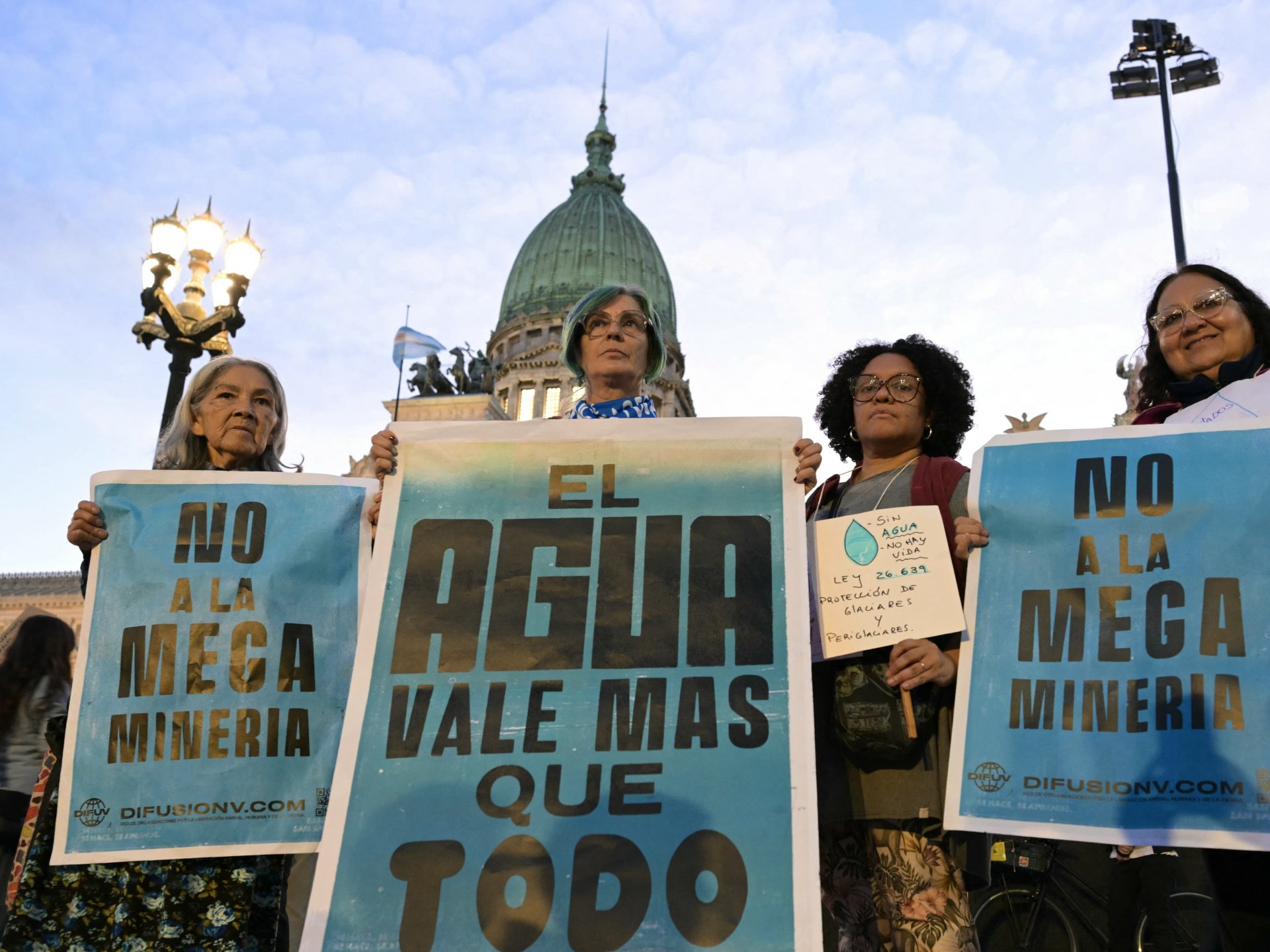
Thousands of people demonstrated outside parliament on Wednesday, with some clashes with police reported. Protesters held signs reading "Water is more precious than gold!" and "A glacier destroyed cannot be restored!" Seven Greenpeace activists were arrested after scaling a statue outside parliament and unfurling a banner urging politicians "not to betray the Argentine people."
Environmental activist Flavia Broffoni rejected the government's sustainability claims, telling AFP that "there is absolutely no possibility of creating what they call a 'sustainable mine' in a periglacial environment." The law takes effect once published in the official gazette.





























The sources also report that the lower house approved the bill with 137 votes in favor, 111 against, and three abstentions.