
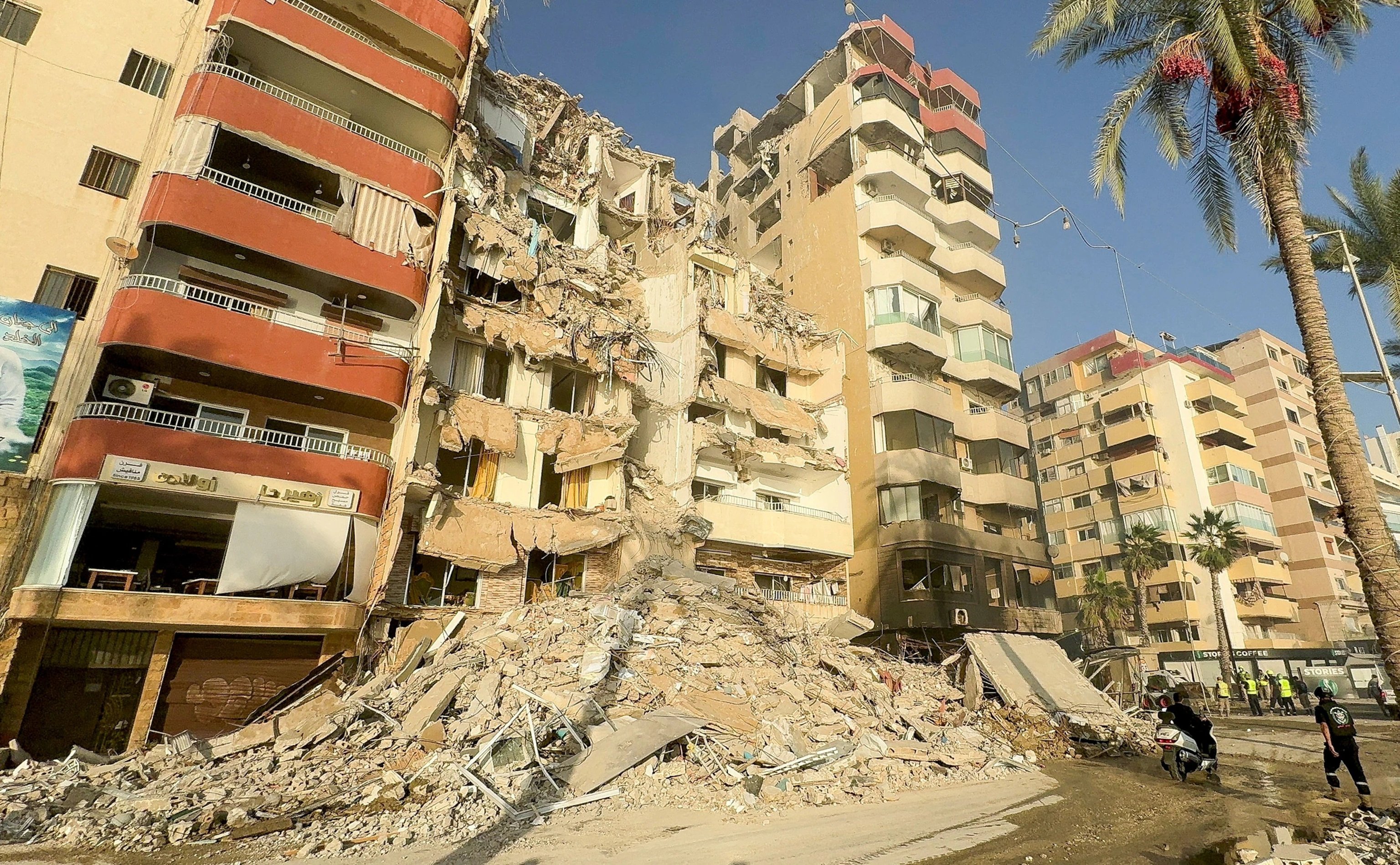





The evacuation order that cleared southern Lebanon
Israel's military posted maps in red on Wednesday ordering every person living south of the Zahrani River to leave immediately. The area equals 14 percent of Lebanon's total territory. FRANCE 24's Claire Paccalin walked through Tyre's abandoned streets where shops stood shuttered and homes sat empty with doors flung open from the rush of departure.
The evacuation zone encompasses Lebanon's southern heartland where more than one million people have already fled their homes since the war began. Israeli military officials describe the operation as targeting "key Hezbollah strongholds" but the evacuation order makes no distinctions between combatants and civilians.
Europe's warnings meet Israeli ground operations
France, Germany, Italy, the United Kingdom and Canada issued a joint statement warning that "a significant Israeli ground offensive would have devastating humanitarian consequences and could lead to a protracted conflict" and "must be averted." Their statement came as Israel's military admitted conducting "limited and targeted ground operations" against the Iran-backed group.
European leaders fear limited incursions could escalate into a full invasion of southern Lebanon, which Hezbollah dominates militarily and politically. The European Union has allocated €100 million ($115 million) for relief supplies. The first shipment of supplies, including medical kits, shelter materials, and recreation kits for children, arrived in Beirut from Copenhagen.
The displacement crisis reshaping Lebanon
As many as 900,000 Lebanese people have been displaced according to an EU spokesperson, with most of the displaced coming from Shiite communities under attack. These displaced Shiites are seeking refuge in areas dominated by Sunni Muslims and Christians, creating new tensions as communities view them as potential Hezbollah supporters who could attract Israeli strikes.
Lebanon's parliament extended its term for two years on Monday, postponing elections originally scheduled for May after determining it was unrealistic to organize a national vote during war and mass displacement. Lebanon has been reeling from a debilitating economic crisis for years.
Why Europe fears this escalation
Julien Barnes-Dacey, director of the Middle East and North Africa program at the European Council on Foreign Relations, said European leaders worry about "a real concern that actually this is precisely the kind of situation that pushes more people from the Middle East to look to flee the region and head to Europe."
The Israeli army has talked about going "up and even beyond potentially the Litani River and depopulating that area," raising risks of internal conflict within Lebanon as different communities turn against each other. Syria's vulnerability alongside Lebanon adds to European concerns about regional stability and migration pressures.
The economic leverage Europe won't use
Despite being Israel's largest economic trading partner, Europe has been unwilling to use economic pressure over the last two years regarding Israel's military actions, according to Barnes-Dacey. The EU could partially suspend the EU-Israel Association Agreement or revive trade restrictions that were considered during Israel's 2025 military campaign in Gaza.
European officials have limited themselves to statements asking and begging Israel not to escalate or widen offensives in Lebanon, Gaza, and elsewhere, according to Barnes-Dacey. "Obviously, the key card that Europeans have been unwilling to play over the course of the last two years when it comes to Israel is the economic card."
Peacekeepers caught in the crossfire
United Nations Interim Force in Lebanon peacekeepers face direct danger as they operate in areas Israel has ordered civilians to vacate. UNIFIL stated on March 6 that "it is unacceptable that peacekeepers performing Security Council-mandated tasks are targeted" after calling on both Israel and Hezbollah to show restraint.
The peacekeepers have occasionally found themselves under fire during clashes between Israel and Hezbollah, complicating their mission to maintain stability in a region now largely emptied of its civilian population.

The UNIFIL statement calling it 'unacceptable that peacekeepers performing Security Council-mandated tasks are targeted' was made on March 6, according to the article.