Supreme Court Kills Trump's Tariffs, He Vows Immediate Replacement
Revised after bias review
 Council News
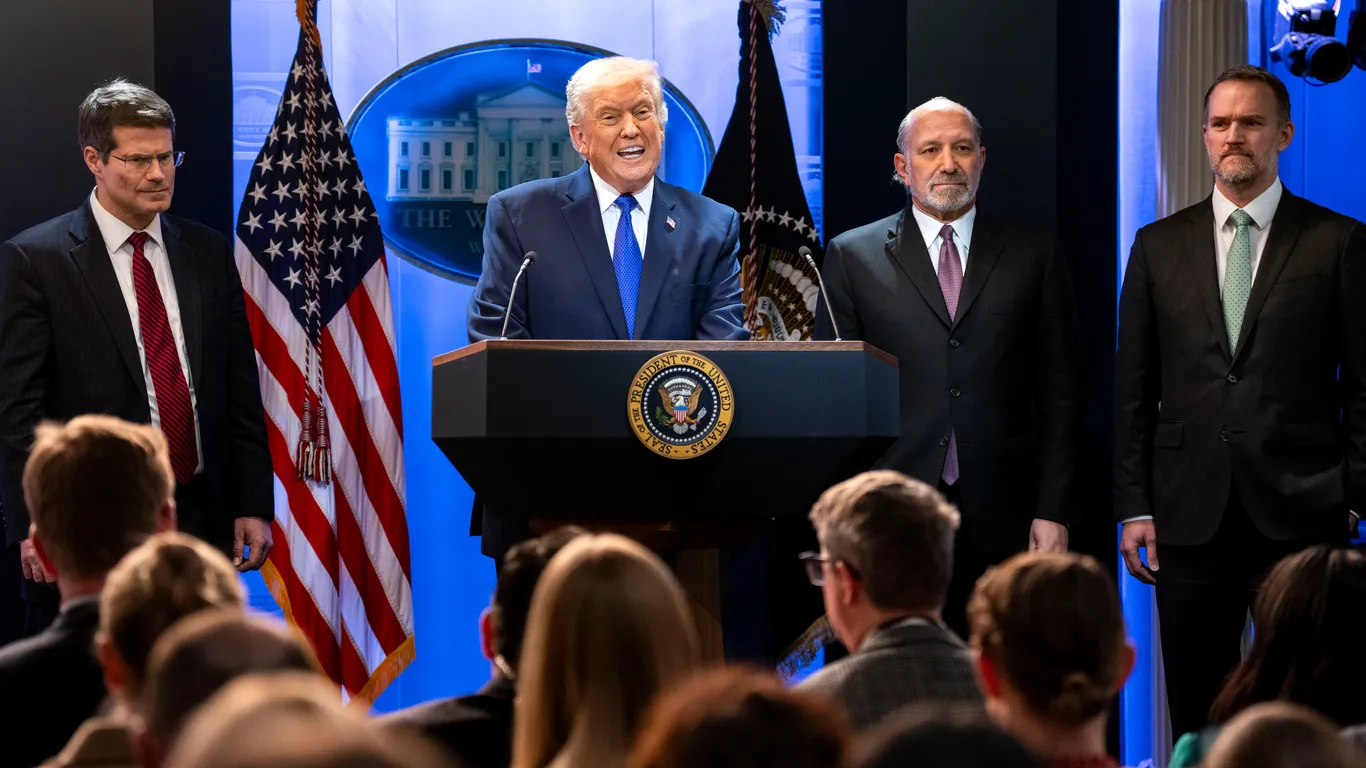





Trump's reaction to the tariff loss, with a high source count, indicates the issue's importance and potential for further policy shifts. People will want to know what he's planning next.
Trump's reaction to tariff loss (35 sources) reveals the political tension and uncertainty ahead on trade policy—a story with genuine conflict and implications for what happens next with tariffs that affect grocery bills and prices.
Trump's reaction to the Supreme Court's tariff ruling reveals significant implications for American consumers and businesses, impacting prices and trade policy. This story is likely to engage readers due to its political drama and direct relevance to economic conditions.
Trump's outburst over a tariff loss reveals ongoing trade policy instability, which could keep prices high on imports; the dramatic, personal tension in his reaction makes it engaging and shareable, as it directly ties to economic pressures people feel daily.
Trump’s tariff loss is the biggest economic-political story of the week; readers want to see how he reacts and what it means for prices. 35 sources confirm it’s the talk of the country.
The Supreme Court struck down President Trump's sweeping global tariffs on Friday, ruling 6-3 that he lacked legal authority to impose them. The justices found that the International Emergency Economic Powers Act does not grant the president power to unilaterally levy tariffs on imports. Chief Justice John Roberts wrote that the Constitution gives Congress, and only Congress, the power to tax and impose duties. It was the first time during Trump's second term that the Court rejected one of his policies.
The ruling eliminated more than 60% of the tariffs Trump had imposed in 2025, according to Fitch Ratings. Yale Budget Lab estimated the overall effective tariff rate would drop to 9.1% without the invalidated levies, compared to roughly 17% if they had remained intact.
Trump announced a new executive order imposing 10% tariffs on imports from all countries under Section 122 of the Trade Act of 1974. This statute allows temporary tariffs up to 15% for up to 150 days, after which Congress must extend them. Unlike the sweeping authority Trump had claimed under IEEPA, Section 122 is narrower and time-limited. Trump also signaled he would launch investigations under other trade laws, including Section 301 (which allows country-by-country tariffs) and Section 232 (which covers national security-related imports like steel and aluminum).
"Countries that have treated us badly will have to pay a price for treating us badly, and countries that have been good to us will be treated very well," Trump said.
Trump's response to the ruling was direct and critical. He said he was "absolutely ashamed" of the Supreme Court and called the decision "deeply disappointing" and "totally defective." He accused the justices of being swayed by foreign interests and criticized them for not addressing the refund question in their opinion.
He singled out Justices Amy Coney Barrett and Neil Gorsuch, both of whom he appointed in his first term. Their decision to join the 6-3 majority was, Trump said, "an embarrassment to their families." He also called the justices a "disgrace to our nation" and said their ruling was "almost like not written by smart people."
Trump expressed frustration with the legislative process for implementing tariffs. "I'm allowed to destroy the country, but I can't charge them a little fee," he said.
The Supreme Court left unanswered a critical question: whether the government must refund the $175 billion in tariffs it collected under the invalidated policy. Companies including Costco, Revlon, and Bumble Bee Foods have already sued in the Court of International Trade seeking refunds. Penn-Wharton Budget Model economists estimate potential refunds could exceed $175 billion.
Trump criticized the Court for not addressing this in its opinion. "Wouldn't you think they would have put one sentence in there saying, 'keep the money or don't keep the money,' right?" he asked. "I guess it has to get litigated for the next two years."
The refund process involves complex logistics. Customs attorney Luis Arandia said the complexity is "mind-boggling," involving more than 20 million tariff entries and over 300,000 importers. Refunds would go to the importer who paid the tariff, not directly to consumers, though retailers could cut prices if they win refunds. The process could take 12 to 18 months.
Trump's new 10% tariff is temporary under Section 122, expiring after 150 days unless Congress extends it. The administration can theoretically restart the clock by declaring another emergency, but that strategy faces legal uncertainty.
Global leaders and businesses are watching closely. European officials said they are analyzing the ruling and awaiting clarity on Trump's next moves. The overturned tariffs had underpinned trade deals with China, the United Kingdom, and Japan totaling trillions of dollars. The status of those trade deals is now uncertain.
Senate Republicans, including Sen. Bernie Moreno of Ohio, are calling for Congress to codify Trump's tariffs into law. Democrats, including Illinois Gov. JB Pritzker, have called for the administration to issue refunds instead. But legislative action in a divided Congress typically takes longer than executive action.
The Supreme Court's ruling removes one source of tariff authority but leaves open the question of what tariffs Trump will impose under alternative legal authorities.
Cross-referenced to ensure accuracy